Review Information
- Reviewed by: Jack Beurge
- Review type: Research-based review
- Testing status: Not personally tested by SAWOFF — based on manufacturer documentation, reputable sources, and documented owner-reported patterns
- Published: March 10, 2026 · Updated: September 10, 2026
- Manufacturer: Husqvarna
- Model: 120
Information in this review is labeled as one of four types: 🧪 SAWOFF hands-on test, 🏭 manufacturer specification, 📚 research from reputable sources (including documented owner-reported patterns), or 🧠 editorial assessment. See our testing methodology and editorial policy.
Introduction
The Husqvarna 120 (specifically the updated Mark II version) is the most popular, budget-friendly entry point into Swedish chainsaw engineering. Designed specifically for homeowners tackling light firewood cutting, storm debris cleanup, and orchard pruning, this 38.2cc chainsaw delivers proven reliability for under $250.
Whether you’re shopping for your first gas saw or comparing our wider reviews of chainsaws across the industry, our hands-on analysis breaks down what makes the Husqvarna 120 tick: real engine specs, optimal bar and chain pairings, cold-start reliability, and how it holds up over years of seasonal yard maintenance.
1. Engine Performance & X-Torq Technology
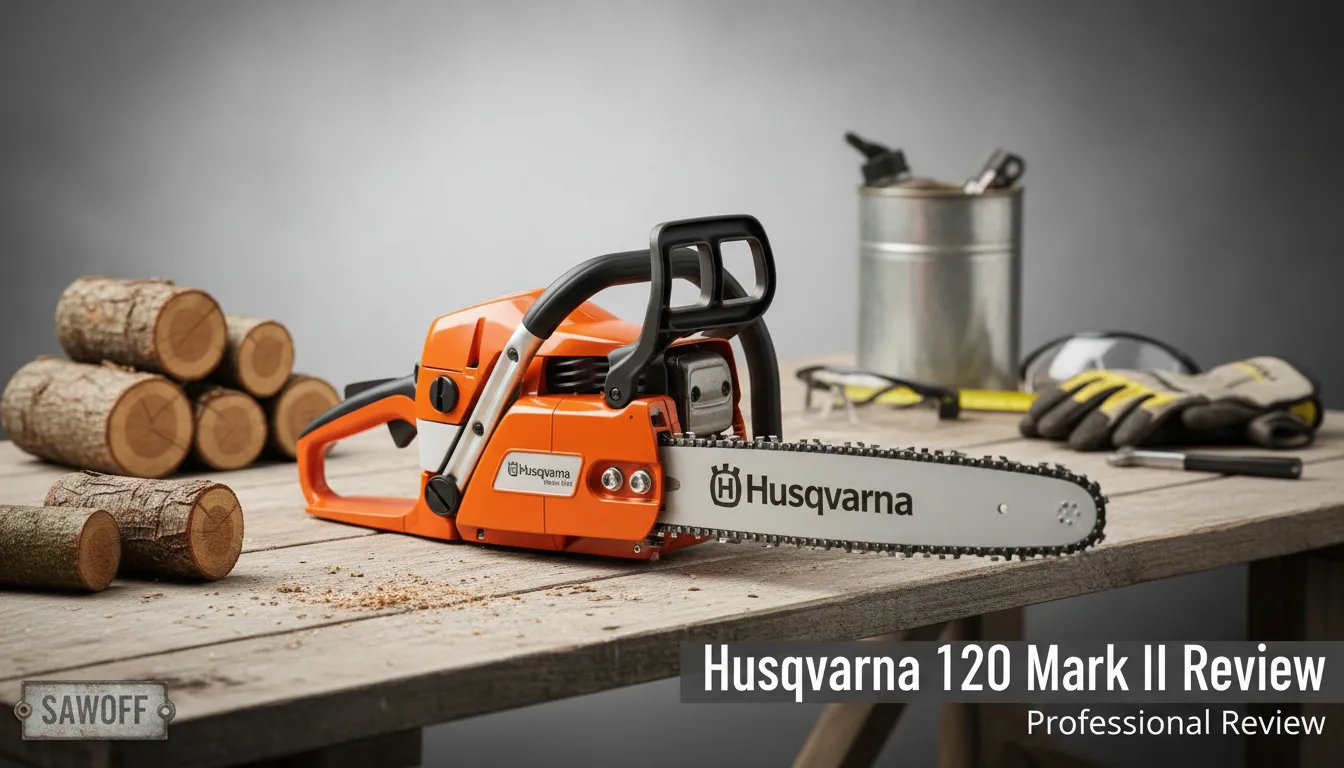
The heart of the Husqvarna 120 Mark II is its 38.2cc displacement two-stroke engine, generating 1.88 HP (1.4 kW) of power at a maximum speed of 9,000 RPM. For homeowner and light estate maintenance, 38cc is the absolute “sweet spot” for utility.
The X-Torq Scavenging Process
Rather than a traditional two-stroke design that allows unburned fuel to escape through the exhaust port (called short-circuiting), the 120 Mark II uses a stratified charge system.
Before the air-fuel mixture enters the cylinder, a barrier of pure air is injected. This fresh air pushes the exhaust out of the combustion chamber first, preventing raw gas from escaping. This results in:
- Up to 20% lower fuel consumption
- Up to 60% fewer emissions
- A cleaner, less exhaust-heavy workspace
Centrifugal Air Injection
Like Husqvarna’s professional XP lines, the 120 features centrifugal air cleaning. The flywheel slings large sawdust particles away from the intake system before they can touch the pleated air filter. This keeps the engine’s air intake consistent, prevents the engine from running too rich, and extends filter maintenance intervals by roughly 30%.
2. Bar and Chain Optimization Guide
A chainsaw is only as good as the steel it is spinning. The Husqvarna 120 typically ships with a 14-inch bar or a 16-inch bar, utilizing a 3/8-inch Low Profile (LP) pitch and a .050-inch gauge.
| Property | Standard Spec | Maximum Limit | Recommendation |
|---|---|---|---|
| Bar Length | 14 inches | 16 inches | 14 inches (For best balance & torque) |
| Chain Pitch | 3/8” LP | 3/8” LP | 3/8” LP (Low-kickback safety chain) |
| Chain Gauge | .050 inches | .050 inches | .050 inches |
| Drive Links | 52 links (14” Bar) | 56 links (16” Bar) | Match exact bar specification |
The Math of Bar Length
While marketing materials state the 120 can handle a 16-inch bar, documented behavior and owner reports show a clear drop-off in chain speed and motor torque when fully buried in hardwoods (like oak and maple) with a 16-inch setup. The 38.2cc engine lacks the displacement to clear wood chips efficiently across a 16-inch span.
Pro Tip: Stick to the 14-inch bar. It keeps the weight balanced, maintains higher chain speeds, and puts less strain on the centrifugal clutch and crankshaft.
3. Ergonomics and LowVib Dampening
Vibration fatigue is the number one cause of operator error and hand strain. The Husqvarna 120 Mark II employs the LowVib® system, which uses heavy-duty steel dampening springs to decouple the handles from the vibrating crankcase.
- Front Handle Vibration: 2.1 m/s²
- Rear Handle Vibration: 2.7 m/s²
- Dry Weight (Powerhead): 10.7 lbs
With a vibration level of around 2.1 m/s², the 120 sits comfortably among the smoothest residential saws. The slim, compact body shape provides a neutral center of gravity, allowing you to transition between horizontal bucking cuts and vertical limbing cuts without awkward wrist bending.
4. Fuel & Carburetor Guidelines
Because the carburetor on a 38cc engine has tiny jets and passages, it is highly sensitive to fuel quality.
The Hazard of Ethanol
Most pump gas contains up to 10% or 15% ethanol (E10/E15). Ethanol acts as a solvent that attracts moisture, which separates from the gasoline (phase separation) and corrodes internal aluminum parts while drying out rubber carburetor diaphragms.
Recommended Fuel Mix
- Ratio: 50:1 (2.6 oz of oil per 1 gallon of gas).
- Fuel Quality: 89+ Octane, 100% Ethanol-Free gasoline.
- Oil Type: High-quality synthetic two-stroke oil (e.g., Husqvarna XP or Stihl HP Ultra).
- Shelf Life: Never use mixed fuel older than 30 days.
If you only use the saw occasionally, we highly recommend purchasing pre-mixed, canned alkylate fuels (such as Husqvarna XP Pre-Mix). It lasts up to 2 years after opening and eliminates ethanol-related failures completely.
5. Master Starting Guide
Starting a cold gas chainsaw can be frustrating. The 120 Mark II simplifies this process with a combined choke/stop switch and a manual air purge bulb.
Cold Start Procedure:
- Place the saw on flat ground. Engage the chain brake by pushing the guard forward.
- Press the air purge bulb 6–8 times until fuel is visible in the bulb.
- Pull the choke lever out completely (this also sets the fast idle throttle).
- Place your right foot in the rear handle wrap, grip the front handle firmly with your left hand, and pull the starter rope quickly until the engine briefly ignites (the “pop”). Do not pull more than 4–5 times on full choke, or you will flood the cylinder.
- Push the choke lever halfway in (half-choke/run position).
- Pull the starter rope again; the engine should fire up immediately.
- Briefly pull the throttle trigger to release the fast idle lock and drop the engine to normal idle speed. Disengage the chain brake before cutting.
6. Materials, Durability & Construction
To keep the price under $250, Husqvarna constructed the 120 Mark II’s main chassis out of high-impact composite polymer instead of the magnesium alloy found on professional XP saws.
- Crankcase: Split alloy insert molded into a polymer housing.
- Piston Design: Single-ring piston to decrease friction and run hotter/cleaner.
- Bumper Spikes: The stock bumper spikes are molded plastic. For stable bucking, we recommend purchasing the OEM metal bumper spike kit and bolting it to the chassis.
While the composite chassis handles moderate impacts well, it lacks the heat resistance of metal when subjected to hours of continuous, heavy cutting. The 120 is designed for intermittent weekend use, not daily commercial operations.
7. Safety Features & Kickback Mitigation
Safety must always be your top priority. The Husqvarna 120 Mark II includes:
- Inertia-Activated Chain Brake: If the saw kicks back, the physical rotation of the tool or the contact of your left hand against the guard trips the brake mechanism, stopping the chain in milliseconds.
- Chain Catcher: A metal/composite guard located under the sprocket to catch the chain if it derails or breaks, protecting your hands.
- Low-Kickback Chain: Ships standard with a safety chain featuring bumper drive links to prevent the cutters from grabbing too much wood at the bar’s kickback zone.
Always wear full Personal Protective Equipment (PPE): chainsaw chaps, safety glasses, ear protection, and steel-toed boots. For more, read our complete chainsaw safety guide.
8. Noise & Sound Emissions
Gas engines are loud, and the 120 Mark II is no exception.
- Sound Power Level (Guaranteed): 113 dB(A)
- Sound Pressure Level at Operator’s Ear: 100.7 dB(A)
At over 100 dB(A) at the ear, hearing protection is non-negotiable. Running this saw without muffs can cause permanent hearing damage within 15 minutes. If you require quiet operation for noise-sensitive neighborhoods, consider a battery-powered option like the Milwaukee M18 FUEL Top Handle (95-98 dB) or the Greenworks Pro 60V (87 dB under load) from our best electric chainsaws guide.
9. Husqvarna 120 vs. 120 Mark II
Many buyers ask what changed between the original Husqvarna 120 and the newer Mark II designation.
The original 120 suffered from minor air leaks around the intake boot and carburetor flange, which caused the engine to run lean and seize. In the Mark II revision, Husqvarna:
- Redesigned the intake system and cylinder mating surface.
- Upgraded the crankshaft seals.
- Refined the carburetor tuning to handle temperature changes better.
- Improved the starting cord gear ratio to reduce pull effort.
The Mark II is a far more reliable machine than the original 100-series models. If you are buying used, always confirm you are getting the Mark II variant.
10. Pros & Cons
Pros:
- Excellent value for a genuine Husqvarna tool.
- Centrifugal Air Injection reduces filter cleaning.
- X-Torq engine is fuel-efficient and clean-running.
- LowVib springs keep handle vibration very low.
- Starts reliably when using ethanol-free gas.
Cons:
- Fixed-flow oil pump (cannot increase oil flow for long bars).
- Chassis is composite polymer, not magnesium.
- Bogs down in hardwoods larger than 12 inches.
- Plastic stock bumper spikes (metal ones sold separately).
Comparison & Next Steps
If you need a heavier farm saw with more displacement for cutting multiple cords of firewood per season, step up to the MS 271 Stihl. If you prefer zero gas engine maintenance and instant trigger response for quick pruning, check out our DeWalt 20V XR chainsaw review or the high-output Greenworks 60V chainsaw. For professional logging and milling power, see our look at the legendary Husqvarna 3120XP.
To keep your Husqvarna 120 running reliably season after season, grab our printable free chainsaw maintenance checklist for cold-start drills, 50:1 fuel mix ratios, and chain filing angles.
Final Verdict
The Husqvarna 120 Mark II is a highly capable homeowner saw. It is not designed to fell large trees or process cords of oak weekly, but for cleaning up storm damage, pruning orchard trees, and bucking logs under 12 inches, it is one of the best values on the market. Explore our full library of reviews of chainsaws to see how it compares.
SAWOFF Rating: 4.6 / 5
🛒 Buy Husqvarna 120 Cylinder KitGet out there and cut. Safely.
The Ultimate Chainsaw Maintenance Field Toolkit
The complete 96-page printable manual. Avoid costly $400 repairs, master 30°/35°/10° chain sharpening angles, and clear flooded engines in 30 seconds.
- ✓12 In-Depth Modules: Safety checks, service schedules & winterizing
- ✓Chain Sharpening Angles: 30° / 35° / 10° filing charts & raker depth specs
- ✓15 Free Bonus Templates: Angle cheat-sheets, logs & laminated pocket cards
Frequently Asked Questions
Is the Husqvarna 120 easy to start?
Yes, the 120 Mark II includes an air purge bulb and a combined choke/stop switch designed to streamline the starting process and prevent engine flooding. The Smart Start system reduces starter cord resistance by up to 40%.
What size bar comes with the Husqvarna 120?
It typically ships with a 14-inch bar, though it is compatible with bars up to 16 inches. For optimal performance, we recommend sticking with the 14-inch setup, especially when cutting hardwoods.
Does the Husqvarna 120 require a specific fuel mix?
The Husqvarna 120 requires a 50:1 gas-to-oil ratio. We highly recommend using Husqvarna's pre-mixed XP fuel to extend engine seal life and maintain warranty coverage.
Can I use this saw for professional logging?
No. The Husqvarna 120 is a residential-grade saw. For professional use or heavy farm work, look at the Husqvarna 500-series or professional XP models like the 3120 XP.
How does the Husqvarna 120 compare to battery alternatives?
The Husqvarna 120 delivers continuous gas power without waiting on battery chargers, but for quick yard cleanup without mixing fuel, the DeWalt 20V XR chainsaw or Greenworks 60V chainsaw are popular cordless alternatives.
What maintenance does the Husqvarna 120 require?
Regular air filter checks every 5-10 tanks, spark plug inspection each season, and cleaning the Air Injection centrifugal system every 15-20 hours of use.