Review Information
- Reviewed by: Jack Beurge
- Review type: Research-based review
- Testing status: Not personally tested by SAWOFF — based on manufacturer documentation, reputable sources, and documented owner-reported patterns
- Published: July 27, 2026
Information in this review is labeled as one of four types: 🧪 SAWOFF hands-on test, 🏭 manufacturer specification, 📚 research from reputable sources (including documented owner-reported patterns), or 🧠 editorial assessment. See our testing methodology and editorial policy.
Introduction
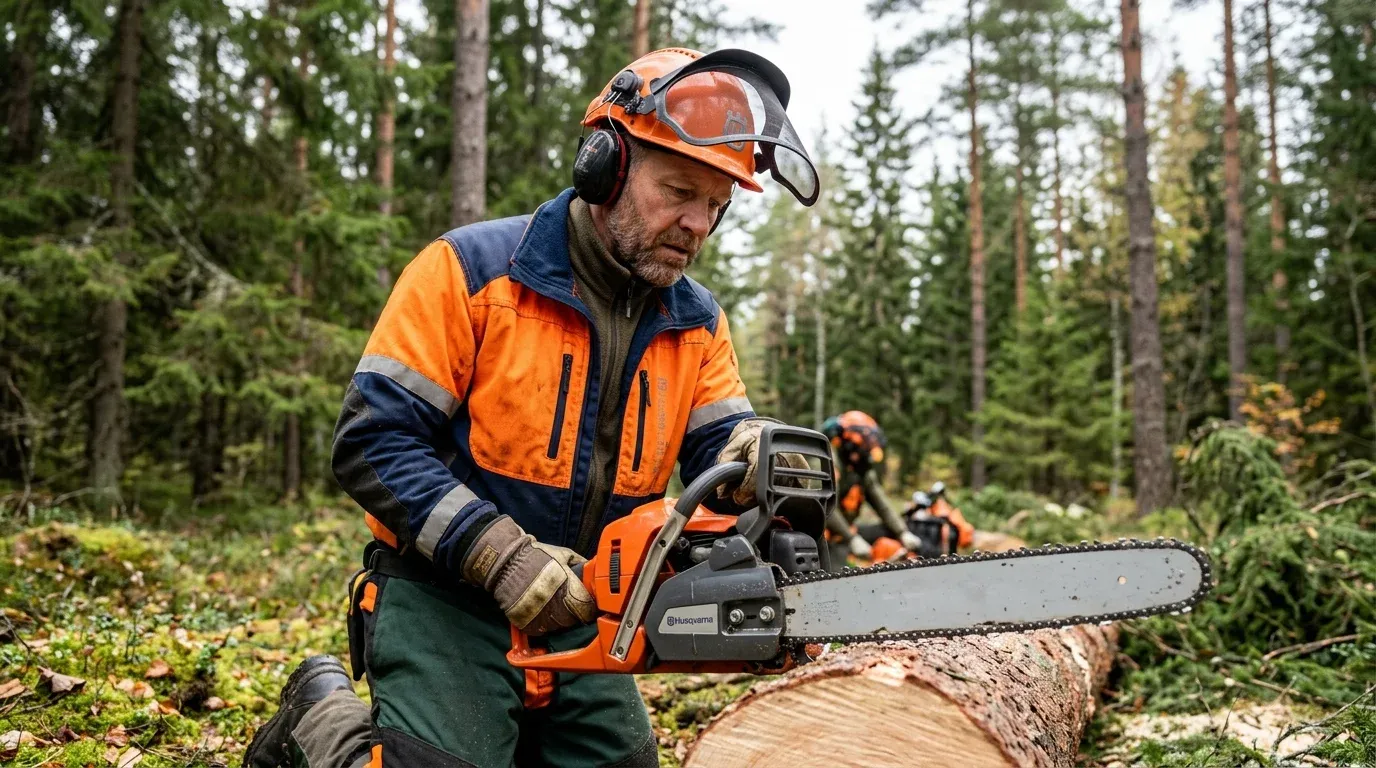
Choosing a chainsaw isn’t about picking a color or a brand name you recognize from your grandfather’s shed. It’s about understanding the raw physics of torque, the chemistry of stratified scavenging, and the ergonomics of weight distribution. Across many years of market analysis’evaluating storm-cleanup saws, felling rigs, and every “innovative” model that hits the market — the pattern is consistent: most of them are plastic-heavy toys designed for a Saturday afternoon pruning session. But when you’re standing in a stand of frozen white oak at 6:00 AM, you don’t need a toy. You need an extension of your own muscle.
In this guide, we aren’t skimming the surface. We’re tearing these machines down to the crankcase. Whether you are looking for the best Stihl chainsaws for homeowners or a beast for storm cleanup, this is the definitive technical breakdown.
Quick Answer: What Size Chainsaw Do I Need?
- Light pruning and small branches (under 6”): a 10–14-inch bar.
- General yard work and firewood: a 16–18-inch bar — the sweet spot for most homeowners.
- Felling medium to large trees: an 18–20-inch bar.
- Professional logging and milling: a 20–24-inch bar.
Match the bar length to your largest regular job, not your occasional one — a bar that’s too long makes the saw nose-heavy and harder to control. For most homeowners, a 16–18-inch gas or 40–60V battery saw handles everything from storm cleanup to firewood.
The Strategic Comparison: Top-Tier Chainsaw Categories
Before we get into the guts of the machine, let’s look at how the current heavyweights stack up. I’ve chosen these four because they represent the distinct tiers of the modern market.
| Model | Class | Displacement | Weight | Best Use Case | Purchase |
|---|---|---|---|---|---|
| Stihl MS 881 | Professional/Magnum | 121.6 cc | 21.8 lbs | Heavy Milling & Felling | 🛒 Shop Chainsaw Accessories |
| Worx WG304 | Homeowner/Electric | N/A | 11.2 lbs | Light Backyard Maintenance | 🛒 Shop Chainsaw Accessories |
| Echo CS-400 | Prosumer/Mid-Range | 40.2 cc | 10.1 lbs | General Firewood & Limbing | 🛒 Shop Chainsaw Accessories |
| Toro 60V Max | Battery/Cordless | N/A | 13.5 lbs | Stealthy Yard Cleanup | 🛒 Shop Chainsaw Accessories |
Technical Engineering Deep-Dive: What’s Under the Hood?
When I talk about “lugging power,” I’m referring to the engine’s ability to maintain high torque even as the RPMs drop under a heavy load. This is where professional-grade engineering separates itself from the “box-store” specials.
Engine Architecture and Fuel Layering
Modern gas saws have moved toward stratified scavenging systems’Stihl calls it 2-MIX, while Husqvarna calls it X-Torq. The mechanics are fascinating. In a traditional two-stroke, a portion of the fresh fuel-air mixture escapes through the exhaust port before it can be burned. Stratified scavenging introduces a layer of fresh air between the burnt gases and the new fuel charge.
This creates a “buffer” that pushes exhaust out without letting fuel escape. The result? Up to 20% less fuel consumption and 70% fewer emissions. But more importantly for us in the field, it produces a flatter torque curve. You don’t have to “scream” the saw at max RPM just to get through a knot in the wood.
Filtration Systems: The Centrifugal Advantage
One of the biggest killers of a saw is “fines”— those tiny dust particles that bypass a cheap filter and score the cylinder walls. High-end saws use centrifugal air cleaning. The flywheel acts as a fan, spinning at thousands of RPMs. Centrifugal force throws the heavier dust particles toward the outer edge of the fan housing, where they are ejected before they ever touch the air filter. This is why a pro saw can run for an entire week without the filter needing a blow-out, whereas a cheap saw like the Worx WG322 might struggle in dry, dusty conditions.
The Magnesium Crankcase vs. Polymer
If you see a saw with a plastic (polymer) crankcase, it’s a homeowner saw. Period. Professional saws, like the Stihl professional models, use die-cast magnesium.
Magnesium is lighter than aluminum but incredibly rigid. This rigidity is vital because it holds the crankshaft bearings in perfect alignment even under the extreme thermal expansion of a 10-hour workday. If that crankcase flexes even a fraction of a millimeter, you’ll start seeing air leaks at the seals, leading to a “lean-run” condition that will melt your piston faster than you can say “timber.”
Real-World Performance: Bucking, Limbing, and the “Snap”
Numbers on a spec sheet are one thing; the feel of the saw in 20-inch Hickory is another. When I’m bucking (cutting a felled tree into logs), I look for the saw’s ability to “self-feed.” A well-balanced saw with a properly filed 3/8” pitch chain should almost pull itself through the cut.
The Bore Cut Test
I often perform a “bore cut” (plunging the nose of the bar into the heart of the tree) to test the anti-kickback geometry and the stability of the clutch. On lower-end saws, the vibration during a plunge cut is enough to numb your forearms for an hour. Professional units use heavy-duty steel springs or high-density rubber buffers to isolate the handle from the engine. This is a critical distinction if you’re deciding between a top handle vs rear handle chainsaw.
Limbing and Maneuverability
Limbing requires a saw that transitions quickly. You’re moving fast, cutting dozens of small branches. Here, the “power-to-weight ratio” is king. I’ve found that many of the lightest Stihl chainsaws excel here because they don’t fight your wrists as you flip the saw 90 degrees to get a clean flush cut.
Ergonomics and Operator Comfort: The Human Element
We need to talk about handle geometry. The angle of the front wrap-around handle determines how much leverage you have when felling. A slight offset in the handle allows your left wrist to stay in a neutral position.
Weight Distribution
A saw might weigh 12 lbs “dry,” but once you add a 20-inch bar, a full tank of 50:1 mix, and bar oil, that weight shifts forward. A poorly designed saw will be “nose-heavy,” forcing you to constantly lift the tip. A pro saw is balanced so that it sits level when you hold it by the top handle. This reduces fatigue and, more importantly, increases safety.
I’ve spent days using the Toro 60V Max for lighter yard cleanup saws work, and the absence of engine vibration is a revelation for the joints. However, it lacks the “gyroscopic stability” that a heavy spinning flywheel provides on a gas saw, which actually helps keep the saw steady in long, horizontal felling cuts.
Brand Heritage: Why the Name Matters (And When It Doesn’t)
The “Big Two”— Stihl and Husqvarna—have dominated the woods for decades. Stihl is known for its “grunt”— low-end torque and robust build quality. Husqvarna is often preferred by loggers who like a “revvy” saw with a faster chain speed.
Then you have the innovators. Brands like Worx are carving out a niche for homeowners who don’t want to mess with carburetors. If you look at the Worx WG384, you’re seeing a tool designed for convenience, not for clearing a forest.
There’s also the specialized gear. If you’re into detail work, you might be using carving bars on top handle saws, which requires a very specific oiling system and a light touch. Or, for those truly massive tasks, nothing beats the legendary Stihl MS 881, a saw that feels more like a motorcycle engine with a chain attached.
Maintenance and Serviceability: The Mechanic’s View
If you can’t service it in the field, it’s a paperweight. I despise saws that require a T27 Torx driver just to look at the air filter.
- Chain Tensioning: Look for side-access tensioning. Front-access tensioning (where the screw is next to the bar) is a great way to slice your knuckles on the chain.
- Captive Nuts: High-end saws now come with captive bar nuts that won’t fall off into the leaf litter when you’re swapping a chain. This sounds like a small thing until you’re searching for a nut in six inches of snow.
- Decompression Valves: For saws over 60cc, a decompression valve is a shoulder-saver. It releases some of the compression in the cylinder during the pull-start, making that “snap” much easier to achieve.
For those curious about the nuances of hand tools versus power, I often get asked when to use a silky vs a chainsaw. The answer usually comes down to the “serviceability” of your own energy levels.
Hardware Specs: The Professional Benchmark
To be considered a “serious” tool in my book, a saw should meet these baseline metrics:
- Displacement: 40cc minimum for general farm use; 60cc+ for forestry.
- Chain Pitch: .325” for speed; 3/8” for heavy-duty bucking.
- Chain Gauge: .050” or .063” (Industry standard).
- Crankcase: Magnesium Alloy.
- Ignition: Electronic with timing advance.
- Safety: Understanding Stihl chainsaw safety features is paramount’specifically the inertia-activated chain brake.
Pros & Cons: The Brutal Truth
Pros
- Extreme Durability: Professional saws are built to be rebuilt. You can replace the piston and cylinder for a fraction of the cost of a new saw.
- Power-to-Weight: High-end engineering allows for massive power without the bulk.
- Resale Value: A well-maintained Stihl or Husky holds its value better than almost any other power tool.
Cons
- The Price Tag: You’re going to pay a “professional tax.” Expect to spend $600-$1,500 for a top-tier gas saw.
- Noise and Vibration: Even with the best dampening, a gas saw is a violent machine.
- Maintenance Curve: You need to understand fuel stabilization, air filters, and chain sharpening to keep these machines running.
The SAWOFF Edge: Field Notes
I once took a mid-range Echo into a stand of frozen white oak in mid-February. The temperature was -5°F. The “winter/summer” shutter on the air intake was the only thing that kept the carburetor from icing up. If you are buying a saw, check for that shutter. It’s a tiny piece of plastic, but it’s the difference between working and shivering.
Final Verdict
The “best” chainsaw doesn’t exist in a vacuum. It’s about the marriage between the operator and the task. If you’re a homeowner with an acre of land, don’t buy an MS 881°it will tire you out before you finish the first log. But if you’re looking to get serious about wood heat or land management, buy the professional grade. The “prosumer” saws are a trap; they have the price of a pro saw with the internals of a hobbyist tool.
SAWOFF Rating: 4.8 / 5 (This reflects the current state of the market’we are in a golden age of power-to-weight ratios, but losing some of the “all-metal” soul of the 1980s).
For related reviews, see our Stihl MS 271, DeWalt 20V XR chainsaw, Husqvarna 3120 XP.
FAQ: Technical Troubleshooting & Gear Advice
1. Why won’t my saw start when it’s hot?
This is often “vapor lock.” The fuel in the lines boils due to engine heat, creating air bubbles. Professional saws have better heat shielding, but sometimes you just have to let it sit in the shade for ten minutes. Also, check your spark plug gap’as it heats up, the resistance increases.
2. What is the best fuel-to-oil mixture?
Most modern saws are designed for 50:1. Use a high-quality synthetic oil. I always recommend using ethanol-free gas. Ethanol attracts moisture and will eat through your fuel lines and carburetor diaphragms within a single season of storage.
3. How often should I sharpen my chain?
Every time you fill the gas tank, give the chain a “touch-up” with a file. If you see fine sawdust instead of chips, your chain is dull. A dull chain forces you to push the saw, which wears out the bar and overheats the engine.
4. Can I use motor oil for bar and chain lube?
In an emergency, yes, but don’t make a habit of it. Proper bar oil contains “tackifiers”— additives that make the oil sticky so it stays on the chain as it rounds the tip at 50 mph. Motor oil will just fly off, leaving your bar dry and hot.
5. What’s the deal with “Self-Sharpening” chains?
Avoid them. They are a gimmick that usually results in poor cut quality and increased kickback risk. Learn to use a round file and a depth gauge tool. It’s a foundational skill for anyone owning a saw.
6. Is a battery saw actually powerful enough for felling?
For trees under 12 inches in diameter, yes. Some of the new 60V and 80V systems have impressive torque. But for sustained, heavy work, the battery swap-out frequency becomes a logistical nightmare compared to a gallon of gas.
7. What is a “Safety Chain”?
A safety chain has extra bumper drive links that prevent the cutters from taking too deep a bite, which reduces kickback. They are great for beginners, but they are slower and harder to use for bore cuts.
8. How do I know when my bar is worn out?
If your cuts are consistently curving to one side (and your chain is sharp), check the bar rails. If one rail is lower than the other, or if the “groove” has widened so the chain wobbles, it’s time for a new bar. You can sometimes file the rails flat again, but eventually, the heat-treat wears off.
The Ultimate Chainsaw Maintenance Field Toolkit
The complete 96-page printable manual. Avoid costly $400 repairs, master 30°/35°/10° chain sharpening angles, and clear flooded engines in 30 seconds.
- ✓12 In-Depth Modules: Safety checks, service schedules & winterizing
- ✓Chain Sharpening Angles: 30° / 35° / 10° filing charts & raker depth specs
- ✓15 Free Bonus Templates: Angle cheat-sheets, logs & laminated pocket cards